NEW!! Light Adjustable Lens
We are proud to be able to offer The Light Adjusted Lens (LAL) from RxSight® to our cataract patients. Until now, surgeons relied upon the accuracy of pre-surgery measurements to determine a cataract patient’s post-operative prescription power. However, with the LAL, a patient’s vision can be adjusted after surgery. The LAL is the only intraocular lens that can be adjusted after surgery, giving the eye time to heal before finalizing the prescription. It also allows patients to possibly be glasses free after surgery! It can correct for distance, near, and intermediate vision, as well as correcting for astigmatism.
Multifocal/Extended Depth of Focus IOL
Life without near vision glasses was not an option for most cataract surgery patients in the past. Even now, many patients choose to have a standard monofocal or traditional toric intraocular lens (IOL) implanted, which will require the use of near vision glasses after cataract surgery. If you have ever wanted to reduce your dependence on near vision glasses, you may be interested in a multifocal or extended depth of focus IOL.
Multifocal and extended depth of focus IOLs are designed to improve both distance and near vision, giving cataract patients their best chance to live free from glasses.
There are various multifocal and extended depth of field IOLs on the market. We have had extensive experience with implanting different types of lenses. Your surgeon can discuss the pros and cons of each lens with you and will help guide you in the lens selection that is best suited for your lifestyle.
TECNIS® Symfony & Symfony Toric Extended Range of Vision IOL
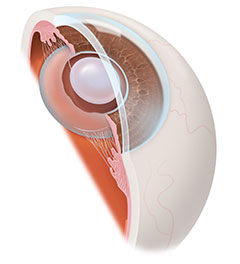
We are proud to have been one of the first practices in the country to be able to offer the Tecnis Symfony® and Symfony Toric® IOLs to our patients. We have been using them for many years and patients are quite pleased with the outcomes. The Symfony® IOL provides continuous, high quality vision that feels natural at all distances. While reading glasses may still be required in some situations such as in dim lighting and for fine print, patients with these lenses may be able to reduce the frequency of wearing near vision glasses after cataract surgery compared to those who have surgery with a standard monofocal or traditional toric IOL. Symfony lenses also come in a toric version for those with astigmatism, allowing patients with astigmatism to be less dependent on near vision glasses.
Acrysof®IQ PanOptix® Trifocal & Toric Trifocal IOL
The PanOptix is a trifocal intraocular lens. A trifocal lens gives patients a full range of vision, from near through far, with less reliance on glasses. PanOptix lens patients are typically quite independent from glasses, but may require them in some situations, especially for fine print.
TECNIS Synergy™️ IOL
The Synergy™️ IOL received FDA approval in May 2021. This advanced lens combines extended depth of focus and multifocal technology. It delivers a wide range of continuous vision.
Considerations for Multifocal/Extended Depth of Focus IOL
Multifocal and extended depth of focus (EDOF) IOLs have advantages and disadvantages. The advantage is enjoying the greatest independence from glasses following cataract surgery. However, because the Symfony, Synergy, and PanOptix lenses are built with a series of rings, it is normal for patients to see halos and glare around lights immediately after surgery. This typically diminishes over time as the brain adapts, although for a small number of people the halos and glare can be persistent and bothersome. It is also possible to need glasses in some situations, especially for very fine print and in dim lighting.
Many people with cataracts are acceptable candidates for multifocal or extended depth of focus IOL implantation. People with certain eye health problems or people who have had prior refractive surgery (LASIK or PRK), may not be good candidates for these lenses. Your doctor will help you decide which IOL is right for you. As always, we are proud to be able to offer advanced lens technology to our patients.
Astigmatism Correction Through Cataract Surgery
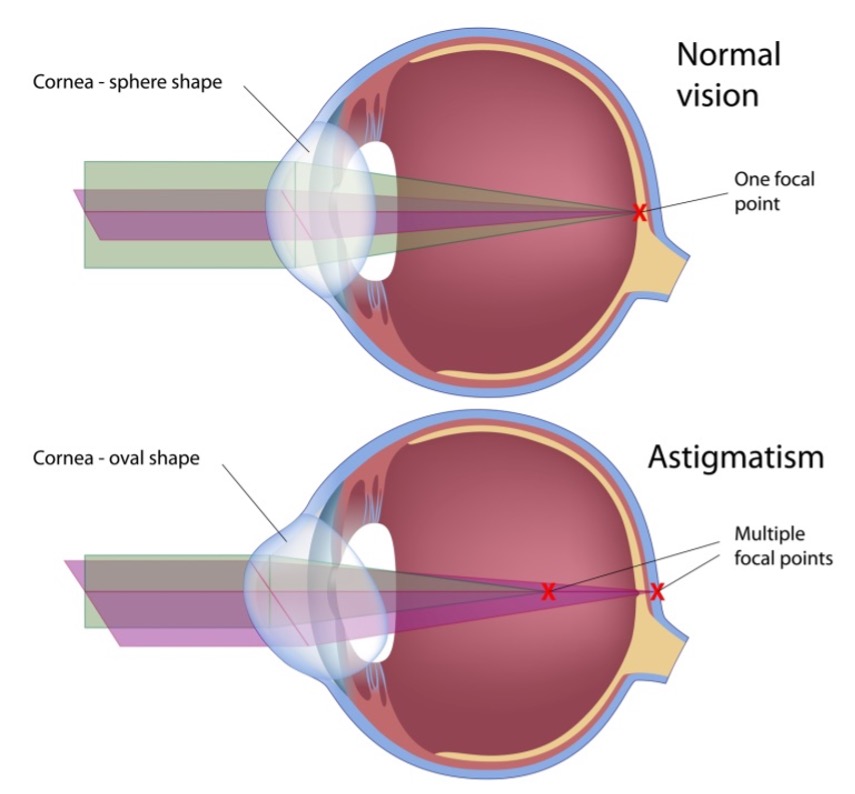
Astigmatism is a natural condition that occurs when the front surface of your eye, called the cornea, is shaped irregularly. This condition is usually present at birth. An ideal cornea is spherical, like a basketball. A person with astigmatism has a cornea that is shaped more like a football. This irregular shape causes blurry vision because light rays are distorted as they enter the eye and don’t focus properly.
Most people have some amount of astigmatism. Small amounts of astigmatism usually don’t affect vision enough to require correction during cataract surgery. However, larger amounts can cause distorted or blurred vision, ghosting, eye strain and headaches, if not corrected with glasses, contact lenses, or special intraocular lenses at the time of cataract surgery.
How do I know if I have Astigmatism?
If you have a high amount of astigmatism, you may have been told about it during eye examinations throughout your life. Prior to surgery, precise measurements will be taken in our office using the latest technology. These measurements will determine whether you have enough astigmatism to warrant correction.
How is Astigmatism corrected?
When a person is younger, astigmatism is typically corrected through their glasses or contact lens prescription, or through laser vision correction.
Thanks to advancements in surgical techniques and technology, your surgeon can now permanently correct for the majority of your corneal astigmatism during cataract surgery. Larger amounts of astigmatism are corrected through the use of a Toric intraocular lens (IOL). Smaller amounts of astigmatism can be corrected by using laser assistance to make microscopic incisions in the surface of the cornea. These incisions, called limbal relaxing incisions (or LRIs), change the shape of the cornea slightly and correct for small amounts of astigmatism, making the vision more focused.
Why correct for Astigmatism?
People with larger amounts of astigmatism often feel that their distance vision is not as good as they would like it to be, without glasses, following implantation of a standard monofocal IOL. They usually require glasses for both distance and near vision after surgery with a standard lens.
When astigmatism is corrected with a traditional Toric lens, people are typically happy with their distance vision without glasses, but do require glasses for near vision. In other words, the traditional Toric lens gives greater independence from distance glasses following surgery for patients with astigmatism.
Toric IOL Options
New! Eyhance Toric IOL
The Eyhance Toric was recently FDA approved, and we have used it in a number of patients at this time. This lens is a monofocal lens that can give a slightly extended depth of focus. This means that it can give greater independence from glasses for intermediate vision (approximately an arms’ length away). Patients with this lens should still anticipate using near vision correction for all near tasks. The extended depth of focus that this lens provides may give a little more “glasses independence” than the traditional IOL for things like looking at a dashboard.
Symfony Toric, PanOptix Toric, or Synergy Toric IOL
In the past, patients who wished to have greater independence from near vision glasses, but who had astigmatism did not have a reliable option available to them to correct their vision at all distances. That has now changed and there are a number of options! We are proud to be able to offer the Symfony Toric, Synergy Toric, and PanOptix Toric lenses for both astigmatism correction and a wider range of vision, free from glasses.
The Symfony Toric gives an extended depth of focus, offering better intermediate and near vision than with a traditional Toric lens. Reading glasses may still be needed in some situations and for extended reading, but patients are much more independent from near vision glasses with these lenses than with either a standard lens or a traditional or Eyhance Toric.
More recently, the PanOptix Toric lens was approved as a trifocal lens and the Synergy Toric was approved as a combination of extended depth of focus and multifocal technology. These lenses give good vision at all distances and may be better at near than the Symfony Toric. Patients may use a weak pair of reading glasses occasionally, but most people are less reliant on near vision glasses. These lenses require extreme precision to implant surgically, so not every patient is a good candidate. Discuss these lenses and their risks and benefits with your surgeon.